Tendinopathies of the Ankle
A tendinopathy is an irritation of the tendon that connects a muscle to the bone. As tendons cross joints and effect movement either a particular position, action, or both can cause symptoms to flare up. Typically massage and physical therapy, coupled with appropriate exercises, stretching, footwear and orthotics make up a complete treatment plan that can help with tendinopathy.
Here are some common tendinopathies that can affect the lower limb:
Achilles Tendonitis
Most of the big visible muscles on the back of the calf all combine into the Achilles tendon which travels through a bit of a tunnel along the rear of the ankle and attaches onto the top of the heel. These muscles work to produce the gas pedal motion at the ankle, the one that lets you stand on your tip toes.
The tendon itself can get simply overworked from a lot of standing, walking, reaching or lifting, however it can also be irritated by certain motions in the heel. The heel kind of wiggles side to side when we place weight on the foot. If the joint is very stiff or we are on very hard floors (like in a hospital or warehouse) the heel will kind of jerk suddenly whenever our foot hits the ground placing a lot of stress on the Achilles tendon right where it connects to the bone. If there is quite a lot of range of motion in this wiggle, like in particularly flat feet, then the Achilles tendon will sometimes rub up against the inside of the tunnel it passes through causing pain and irritation in lower, rear calf.
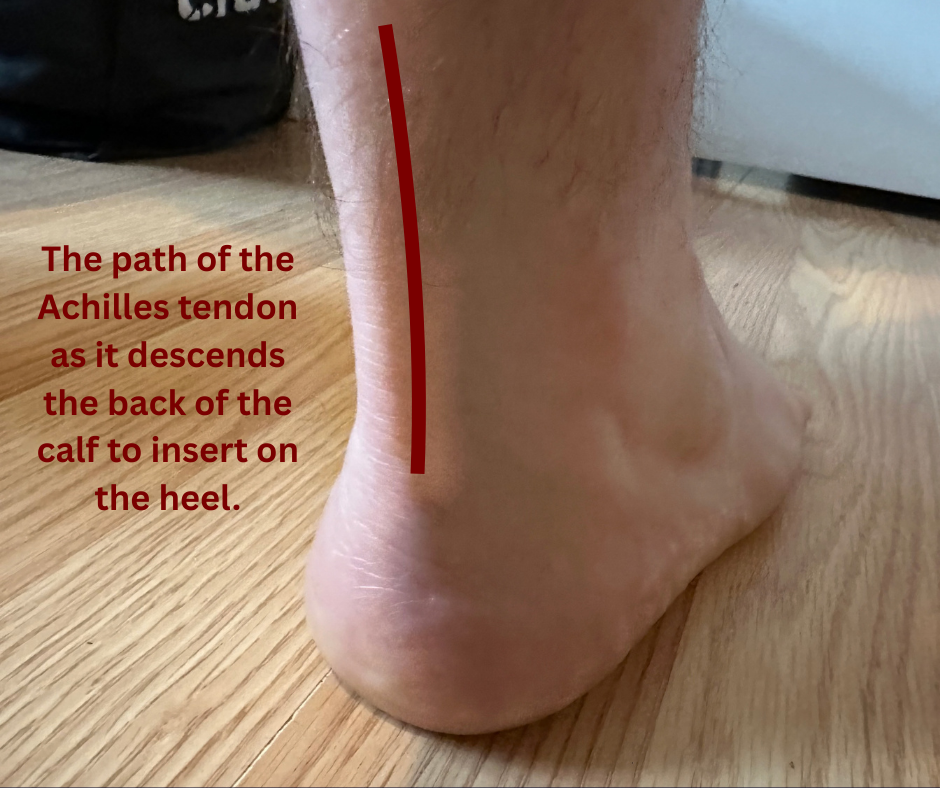
The dark red line shows the path of the Achilles tendon down the back of the calf. If the heel twists or tips to the left or the right it will put a shearing force on the Achilles tendon or make it rub up against the inside of its sheath.
Custom orthotics with an appropriate amount of rearfoot cushioning or a firm, deep heel cup, can help improve shock absorption or stability respectively. A temporary, mild lift in the heel can also be used to reduce some of the strain in the Achilles tendon while it is healing.
Posterior Tibial Tendon Dysfunction – PTTD
Tibialis posterior is a muscle deep in the back of the calf, underneath all the big ones that are related to Achilles Tendonitis. This tendon doesn’t connect in the back of the heel, but rather travels from the rear calf, around behind the ankle bone (medial malleolus), where it finally connects on the middle side of the foot around the apex of the arch.
Tibialis posterior will flex the ankle down, like pushing on a gas pedal; tip the sole of the foot inwards; and it helps to hold up the arch of the foot. If the arch tends to collapse or is quite flat, it can pull the tendon of tibialis posterior around the ankle bone quite painfully and the muscle will be working overtime to try to support the fallen arch. The arch of the foot may bulge towards the midline during weightbearing and there may be swelling along the inside of the ankle especially behind the medial malleolus.
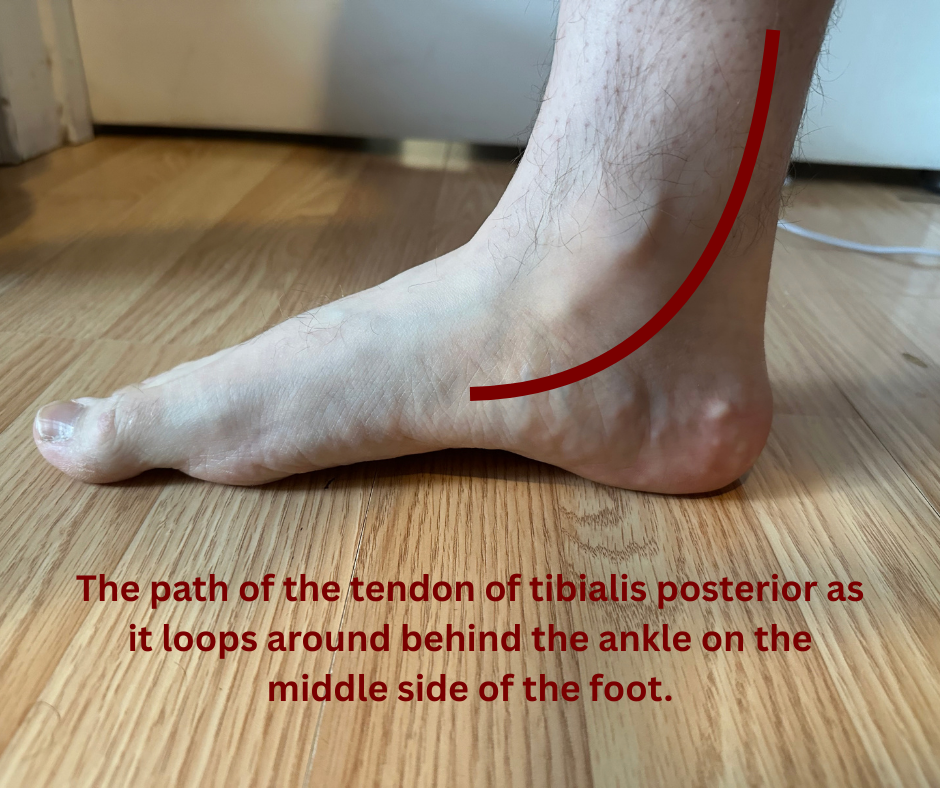
The dark red line shows the path of the tendon of tibialis posterior. If the arch of the foot drops down a lot it will pull on the tendon, make it stretch and rub up against the bones around the inside of the ankle.
Custom orthotics and footwear with firm arch support and a stable structure that helps prevent the arch from collapsing can help with PTTD.
Peroneal Tendonitis
The peroneals are a group of muscles on the outside of the calf that work to firmly plant the foot on the ground and prevent it from rolling over such that the sole faces towards the middle. The tendons run along the outside of the ankle behind the visible ankle bone (lateral malleolus) and attach to both the outside border of the midfoot and right on the bottom of the foot.
Any action that rotates the foot inwards, in the classic ‘ankle sprain’ direction, will put a lot of stress on the peroneal tendons. In fact, these tissues are one of the commonly injured areas during an ankle inversion. Folks who tend to roll their ankles or have particularly high arches (which tend to tip the foot into inversion) are particularly prone to peroneal tendonitis.
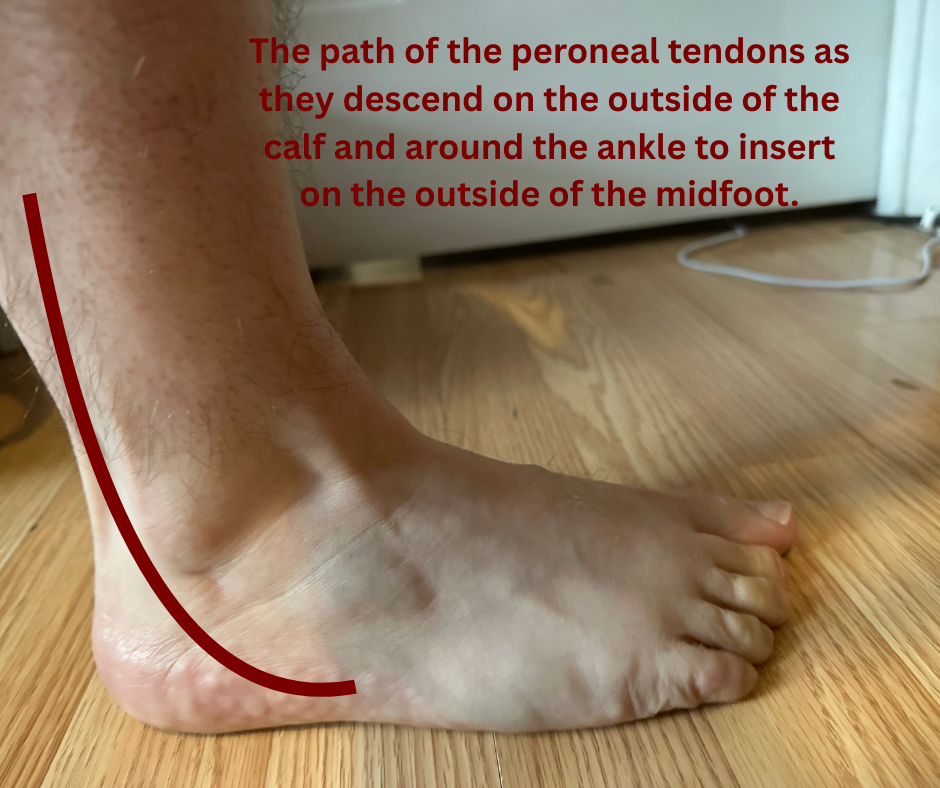
The dark red line shows the path of the tendons of the peroneal muscles on the outside of the calf. If the foot has a tendency to roll inwards it will pull the tendon around the outside of the ankle.
Footwear with a firm, stable midsole and limited arch support can help reduce the tendency for ankle inversion that can irritate peroneal tendinitis. Likewise custom orthotics with either posting or even a wedge on the outside of the foot can reduce pain and inflammation along the outside of the ankle.