In-Toeing AKA Pigeon Toe
This is when an individual's toes point inwards. Most folks typically have about 10-12 degrees of out-toeing, that is, if they were standing on the center of a clock face, facing towards 12, their left foot would point at 11 and their right foot would point at 1. When the feet start to point more towards 12 or even further inwards it can result in fatigue, clumsiness, and even pain in both the feet and legs.
In-Toeing is most common in children and adolescents and typically has three different causes:
Metatarsus Adductus
In this case the foot itself turns inwards at about the halfway point, making it look kind of banana shaped. The fancy words refer to the metatarsals (the long bones in the middle of the foot) and adductus (being pulled towards the centreline of the body).
Tibial Torsion
The shin bones are rotated inwards. This is a twisting kind of rotation that occurs between the knee and the ankle. Of note is that this condition occurs entirely within one length of rigid bone and does not cross any joints.
Femoral Anteversion
The wording on this one is a little more complex. Femoral refers to the thigh bone, so this is primarily concerning the area around the hip and thigh. Eversion is turning something away from the midline, which in this case would mean that the thigh rotates away from 12 on the clock face. However the prefix ante means opposite, so the thigh is actually turning inwards. Femoral anteversion itself can be due to multiple causes, a twist in the femur bone itself, an unusually angled neck of the femur where it connects to the hip joint, or muscular imbalances at the hip.
All of these root causes of in-toeing typically affect children or adolescents and often get corrected through growth. As people age into adulthood they tend in-toe less and less as the skeleton grows and matures.
An assessment with a pedorthist can help determine what the root cause of in-toeing is by observing gait and stance, and especially looking at the relationship between the foot, ankle, knee and hip to determine where the rotation of the leg is occuring. If the in-toeing is mild or asymptomatic it is often recommended that caregivers monitor the situation and we wait to see if growth resolves the in-toeing.
If there is fatigue, pain, tripping or stumbling caused by the in-toeing then there are a few things that can be done to help.
For in-toeing with a root skeletal cause the options are typically changes in footwear, which a pedorthist can help out with, or serial casting/surgical intervention. These last two are the kinds of talks where you would be referred to an orthopedic surgeon or a similar professional.
For soft tissue causes the potential treatments open up a bit, particularly in the case of femoral anteversion. When you turn your foot to point in different directions you are (often) rotating your entire leg at the level of the hip. You will notice that your knee and your ankle rotate at the same time. In a case where there is limited flexibility or muscle strength imbalances physiotherapy can be helpful for reorienting the hip and learning more mechanically sound walking patterns.
Below is a standard set of rigid orthotics, most often used to help support flat feet.
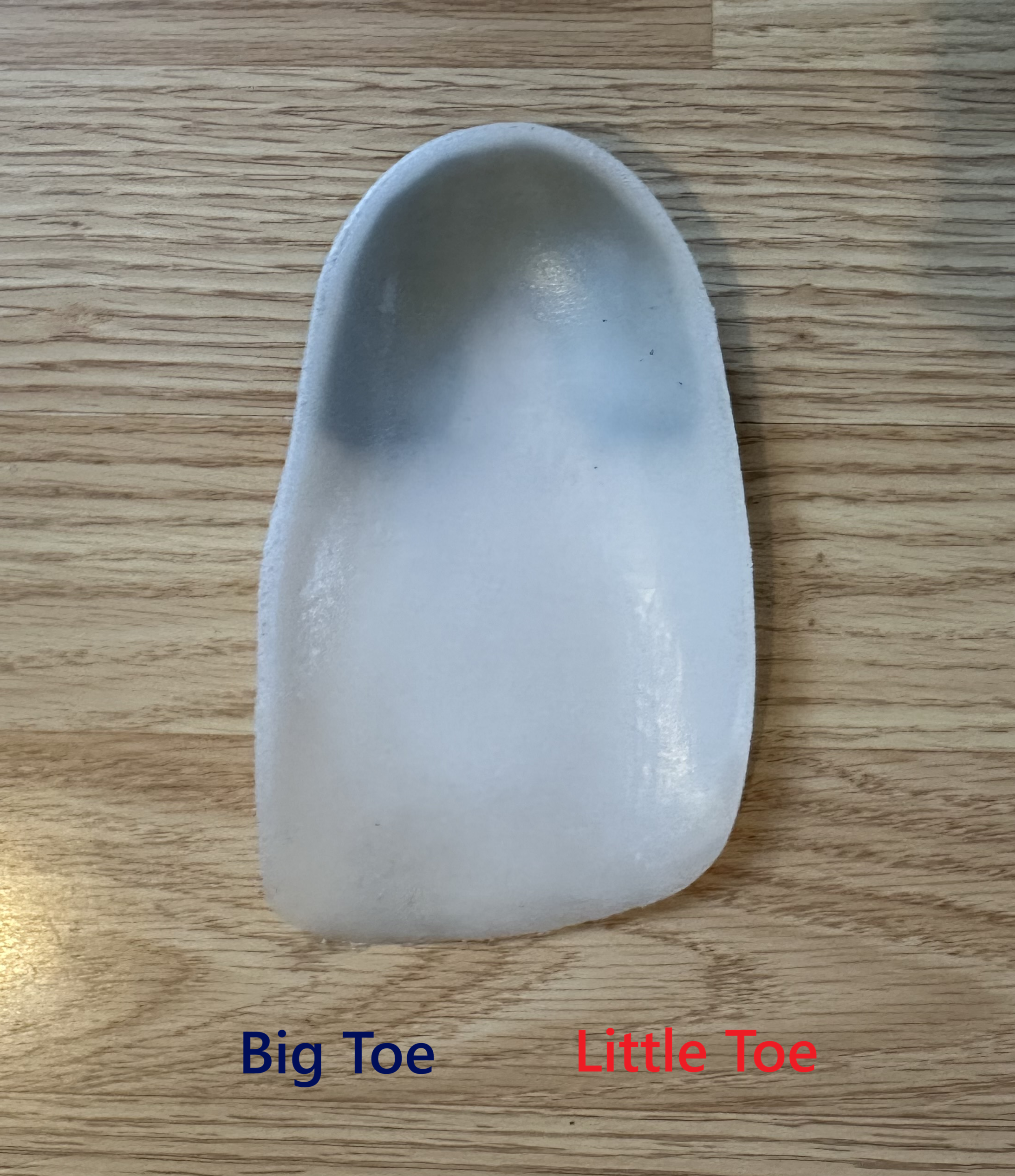
A typical rigid orthotic for the left foot. The front edge ends just before the ball of the foot near the base of the toes.
A pedorthist can also fabricate a set of orthotics with what is called a gait plate. Essentially an extension along the end of a rigid pair of orthotics that acts to promote out-toeing.
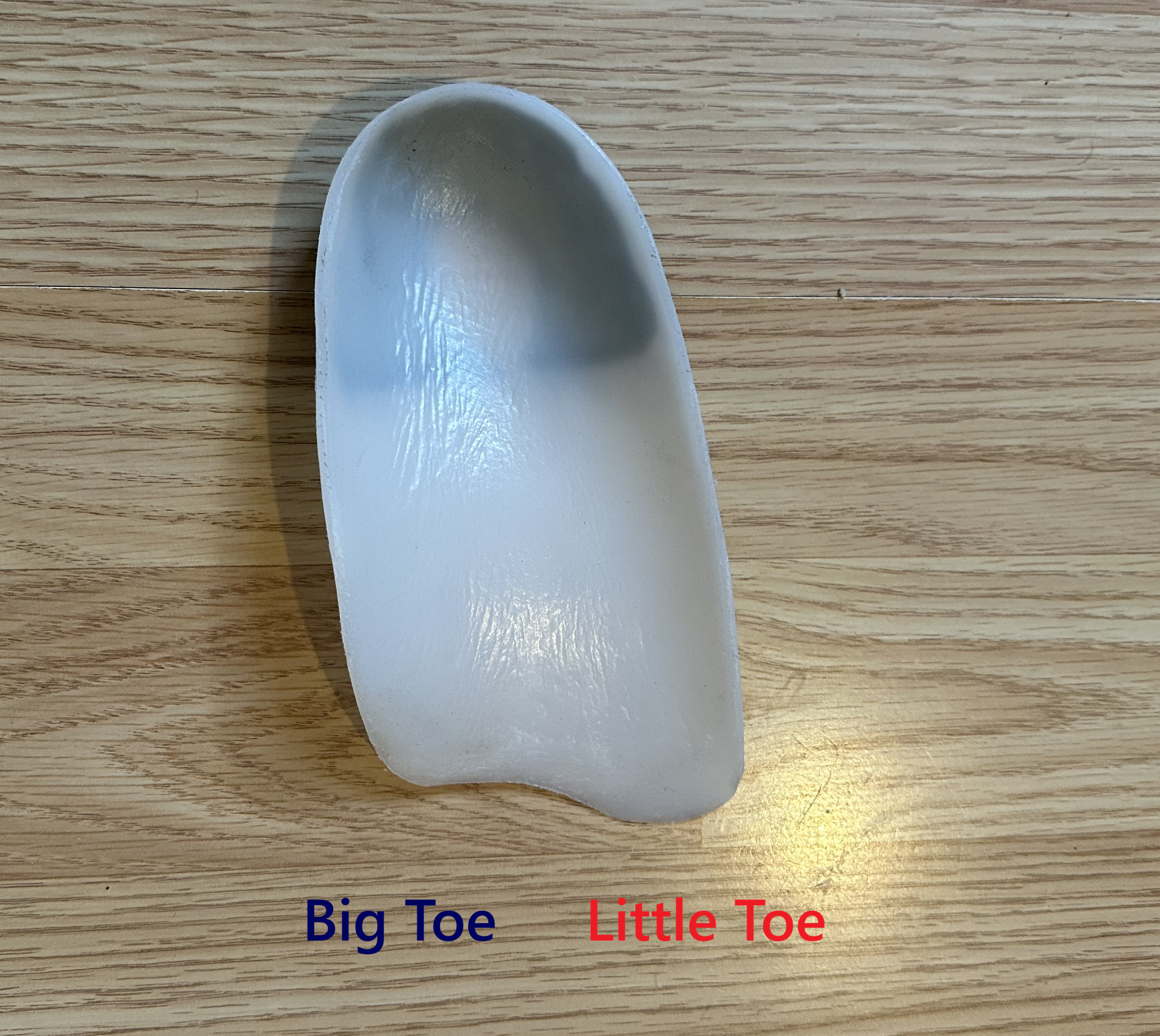
A rigid left orthotic with a lateral (on the outside) gait plate. It is designed to help correct in-toeing.
The rigid extension goes under the baby toe and the toe next to it. This makes it just a touch more difficult for the body weight to progress over the outside of the foot in the way it typically does during in-toeing. So the natural response from the user is to intentionally, actively out-toe so that their body weight can progress over the easier part of the orthotic. It acts kind of like a subtle training guide for promoting more out-toeing and is best paired with physiotherapy that is more directly teaching folks these altered walking patterns as well.
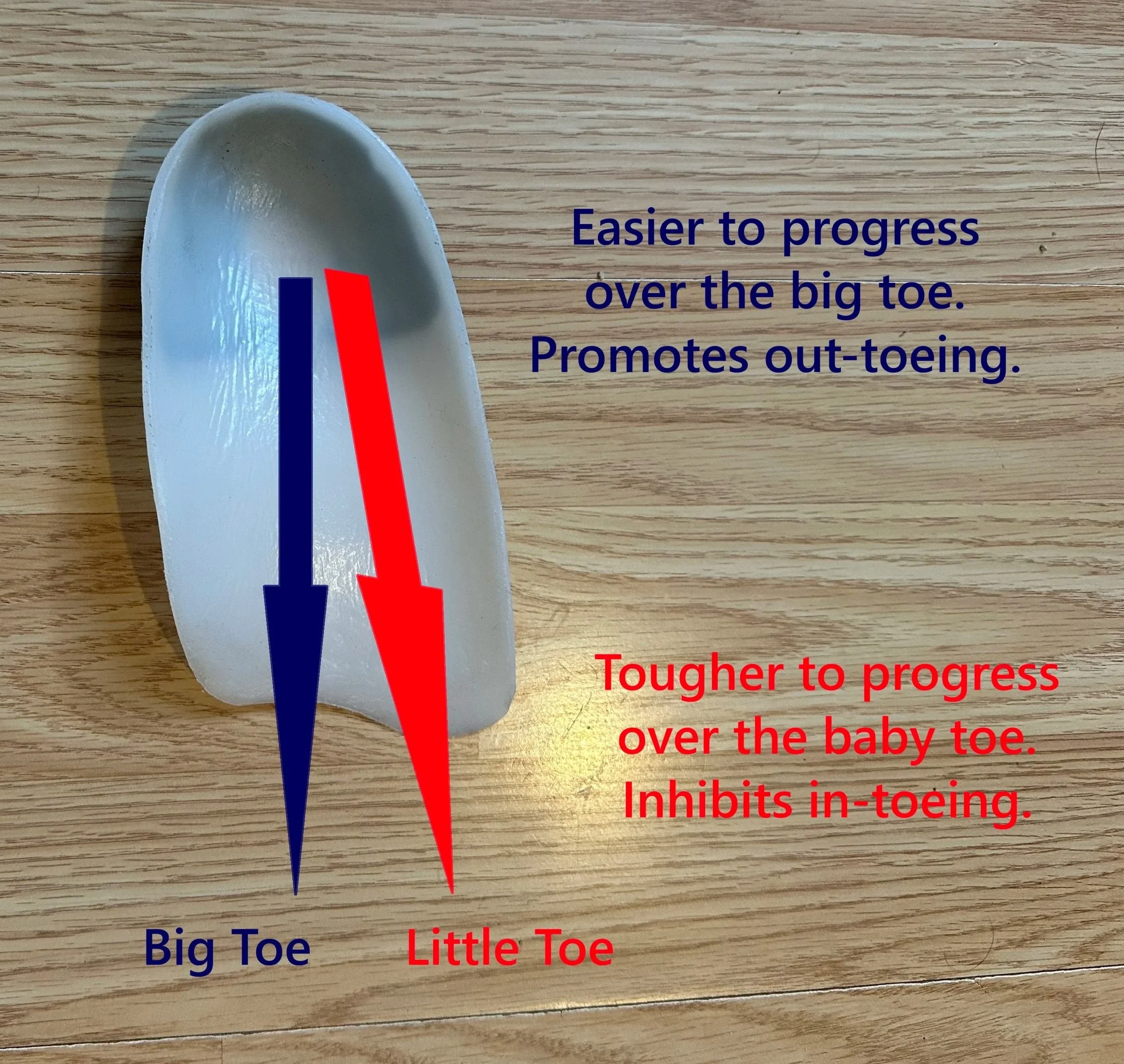
The same left orthotic with a lateral gait plate. The red arrow shows how it is more difficult for the body to progress over the outside of the foot over the little toe. The blue line shows the easier path of progression along the middle aspect of the foot. This will guide the wearer towards externally rotating the hip and walking with more out-toeing.
An orthotic with a gait plate doesn't force a method of walking but it can help promote a more stable and efficient gait pattern long term. It is common for this type of orthotics to be used for a while until the soft tissues of the leg and hip have increased in strength and flexibility to the point where walking without the orthotics is pain and pathology free, although the timeline on this will vary widely from individual to individual, from months to years.